How Music Teachers Can Use AI to Track Student Progress Between Lessons

A practical guide for music educators who want to extend their impact beyond the lesson hour - without adding to their workload.
Key Takeaways
- Between-lesson practice can be hard for a teacher to observe. Recordings and focused practice notes can help make the next lesson more useful.
- The biggest challenge for music teachers is that students practice unsupervised for 6 days between weekly lessons, often reinforcing mistakes with no feedback
- AI performance coaching tools allow teachers to assign specific practice tasks and review objective progress data before the next lesson
- Teachers who use practice accountability tools report that students arrive significantly better prepared, allowing lesson time to focus on musicality and interpretation rather than basic error correction
- The model is not "AI replacing the teacher" - it is "AI extending the teacher's reach" into the 6 days per week when the teacher is not present
The Problem Every Music Teacher Faces
Music teachers can use AI coaching tools to stay connected to student practice between weekly lessons - seeing what each student worked on and the timestamped moments in their recordings worth working on next - without watching hours of practice videos or adding to their workload.
You teach a student on Monday. You explain that they are rushing the chorus and going flat on the high notes. You demonstrate the correct approach. The student nods, seems to understand, and goes home to practice.
Six days later, they return. They have been practicing - but they have been practicing the same mistakes all week, because they could not hear the problems you identified. They are no closer to fixing the issues, and you spend the first 15 minutes of the next lesson re-diagnosing the same problems.
This cycle is one of the most frustrating realities of teaching music. The lesson hour is valuable, but what happens in the other 167 hours of the week determines whether the student actually improves.
Why Students Do Not Improve Between Lessons
Research in music education identifies three core reasons students fail to make progress during unsupervised practice:
1. They need a separate chance to listen. A student can replay a recording to focus on a passage without also performing it. In a listening experiment, six musicians with relative pitch judged 63% of the intervals as in tune when only 23% were musically accurate (Siegel & Siegel, 1977). That result is about interval perception, not a measurement of students assessing their own singing.
2. They practice the wrong things. Without specific guidance, students default to playing what they already know well - the comfortable parts - rather than drilling the difficult sections. Studies on deliberate practice (Ericsson, 1993) show that practicing easy material produces almost no skill improvement.
3. There is no accountability. A student who tells you "I practiced every day" may genuinely believe it. But without a record of what they practiced, how they sounded, and whether they improved, there is no way to verify progress or redirect effort.
How AI Practice Tools Solve This
AI performance coaching platforms like Performance Coach give teachers a way to maintain a feedback loop with students between lessons - without requiring the teacher to watch hours of practice videos or send daily check-in messages.
The Teacher Workflow
During the lesson:
- Identify the specific sections the student needs to work on (e.g., "Verse 2, bars 9-16 - you're going flat on the ascending phrase")
- Assign those sections as practice tasks in the AI coaching platform
- Agree on one focus for the week (e.g., "Keep the ending of each phrase steady")
Between lessons:
- The student records themselves practicing the assigned sections
- The AI reviews each recording and points to the specific moments to work on, each tied to a timestamp the student can replay
- When the student records a second take, a Take 2 comparison shows how the two takes differ
- The student can share what came back, so the teacher sees the same timestamped moments
At the next lesson:
- The teacher reviews the moments flagged in the student's recordings before the lesson
- Instead of re-diagnosing known problems, the teacher can start where the student left off
- Lesson time focuses on musicality, interpretation, and technique - the high-value areas where human teachers are irreplaceable
What Teachers See
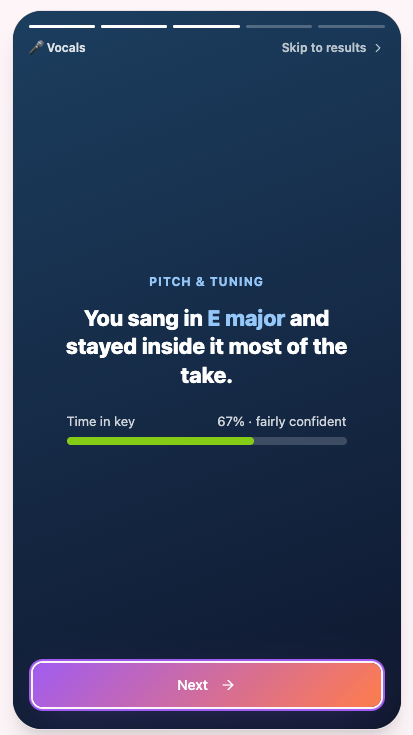
For each recording, the feedback is a set of specific moments worth working on, each tied to a timestamp you can replay together, with what to try next. When the student records a second take, the Take 2 comparison shows how the two takes differ.
That gives you a concrete starting point for each lesson: listen to the flagged moments, hear the second take against the first, and pick the next focus. If you teach voice or guitar and want to use this with your students, see performancecoach.ai/teachers.
Why This Model Works for Teachers
It Solves the Burnout Problem
For a private teacher paid by the lesson, adding teaching hours also adds work. A recording and a short practice note can help connect lessons without asking the teacher to watch every practice session. This is a workflow suggestion, not a claim about teacher attrition or measured time savings.
AI practice tools change this equation. By providing value to students between lessons, teachers can:
- Justify higher lesson rates because students make faster progress
- Retain students longer because measurable improvement keeps students motivated
- Differentiate from competitors who offer only the traditional one-hour-per-week model
- Scale their impact without scaling their hours
It Creates a New Revenue Stream
Teachers can incorporate AI coaching subscriptions into their teaching packages:
- Standard lesson package: $200/month (4 weekly lessons)
- Premium package: $249/month (4 weekly lessons + AI practice coaching between sessions)
The premium package costs the teacher nothing in additional time but provides significantly more value to the student - and the student's measurable progress becomes a powerful retention and referral tool.
It Makes Lesson Time More Productive
When a teacher no longer needs to spend the first 15 minutes of each lesson re-identifying problems the student should have been working on all week, that time opens up for the activities where human teachers are most valuable:
- Musical interpretation and expression
- Performance technique (posture, breathing, hand position)
- Ensemble skills and collaboration
- Stage presence and confidence building
- Music theory applied to the student's specific repertoire
- Creative development and artistic voice
These are the areas that justify premium lesson pricing and create lifelong student loyalty.
Getting Started: A Teacher's Quick-Start Guide
Week 1: Set Up
- Create a teacher account on an AI performance coaching platform
- Add your students to your studio roster
- Choose 2-3 students to pilot the system with
Week 2: Assign First Tasks
- During each pilot student's lesson, identify one specific section to work on
- Record a quick baseline of the student performing that section
- Upload it together so the student sees the process
- Agree on one focus for the week
- Ask the student to record themselves 3-4 times before the next lesson
Week 3: Review and Adjust
- Before each lesson, review the moments flagged in the student's recordings
- Note which students practiced and which did not
- During the lesson, start with: "I can see you've been working on the chorus - let's listen to the moments that came up and build on them."
- Adjust next week's assignments based on what you hear in those moments
Week 4: Evaluate and Expand
- Assess whether pilot students are making faster progress
- Gather feedback from students on the experience
- If results are positive, expand to your full studio
- Consider incorporating AI coaching into your lesson package pricing
Frequently Asked Questions
Will AI coaching make my students not need me anymore?
No. AI coaching points to moments in a recording worth working on - it does not teach musicality, correct technique, design curriculum, or provide the encouragement and accountability of a human relationship. Students who use AI coaching between lessons typically become more engaged with their lessons, not less, because they arrive with specific questions based on what they discovered during practice. The AI identifies problems; the teacher teaches the solutions.
Does this add work to my teaching load?
The system is designed to require minimal teacher involvement between lessons. Students use the AI tool independently. Reviewing the flagged moments in a student's recording is a quick glance - not hours of video review. The net effect is typically a reduction in your workload because you spend less lesson time on basic problem identification.
What age group does this work for?
PerformanceCoach accounts are for students 13 and up. The feedback is delivered in clear, encouraging language appropriate for learners.
How much does it cost for my studio?
AI coaching platforms typically offer teacher/studio pricing at $49-99 per month for a roster of students, which is significantly less than the value it adds to your teaching packages. Many teachers pass the cost through to students as part of a premium lesson package, making it revenue-positive from day one.
What if my students cannot afford another subscription?
Consider bundling the AI coaching into your lesson rate rather than offering it as an add-on. A small increase in your lesson package price ($10-15/month) covers the cost of the tool while providing significantly more value. Alternatively, offer a standard package (lessons only) and a premium package (lessons + AI coaching) and let students choose.
Does this work for group lessons?
Yes. Teachers who run group classes can assign section-specific practice to the entire group and track which students are keeping up. This is particularly valuable for worship teams, school ensembles, and community music groups where coordinated preparation is important.
The Teacher's Competitive Advantage
Music teaching is evolving. The teachers who will thrive in the next decade are those who extend their impact beyond the lesson room. AI performance coaching is one of the most practical ways to do this - it provides real value to students, differentiates your teaching practice, and creates measurable outcomes that drive retention and referrals.
The best part: it does not require you to be a technology expert. If your students can record a video on their phone, they can use AI coaching. And if you can listen to a short list of flagged moments, you can use them to become an even better teacher.
Start Your Teacher Pilot
Set up your studio on Performance Coach and give your students objective feedback between every lesson.
Free for 30 days. See which students actually practice - and watch them improve faster.
References
-
Ericsson, K. A., Krampe, R. T., & Tesch-Romer, C. (1993). The role of deliberate practice in the acquisition of expert performance. Psychological Review, 100(3), 363-406.
-
Hattie, J., & Timperley, H. (2007). The power of feedback. Review of Educational Research, 77(1), 81-112.
-
Pfordresher, P. Q., & Brown, S. (2007). Poor-pitch singing in the absence of "tone deafness." Music Perception, 25(2), 95-115.
-
Siegel, J. A., & Siegel, W. (1977). Categorical perception of tonal intervals: Musicians can’t tell sharp from flat. Perception & Psychophysics, 21(5), 399-407. doi:10.3758/BF03199493.
-
Duke, R. A., Simmons, A. L., & Cash, C. D. (2009). It's not how much; it's how. Journal of Research in Music Education, 56(4), 310-321.
-
Miksza, P. (2015). The effect of self-regulation instruction on the performance achievement of college-level music students. International Journal of Music Education, 33(3), 308-323.
Keywords: AI for music teachers, music teacher technology, track student progress music, practice accountability music students, AI music teaching tools, music studio technology 2026, how to use AI in music lessons, music teacher burnout solutions, student practice tracking